
A card for your door, and one for your wallet
Two pages. The first is a notice for your front door and needs no scissors. The second holds two wallet cards and one straight cut. Both carry a code that opens everything you wrote about your animals.
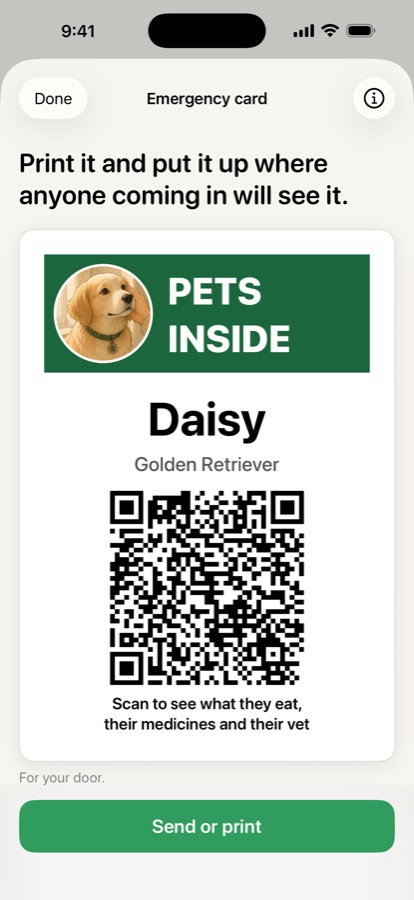
This is not a new idea. It is an old one, printed properly.
The ASPCA has recommended a rescue alert sticker for years: put it on or near the front door, and make sure it says the types and number of pets in your home, along with your vet's name and number.
That advice is right, and it stops at the advice. Nobody hands you the sticker. Between "you should have one" and an actual piece of paper on a door there is a gap, and that gap is where most people give up.
Where we do it differently, and why
The count and the kinds of animal go on the door, because that is what somebody standing outside needs to know in one second. The vet's telephone number does not.
A front door is read by everybody who walks past it — the postman, a neighbour, somebody who should not be there. So the vet's number, the feeding, the medicines and the rest sit behind the code, one tap away for a person who has a reason to look, and invisible to the street.
What is on it
- How many animals are inside, and what they are
- Their names, and their breed if you said it
- A photograph, if you added one
- A code that opens their instructions
What is never on it
- Your address
- Your telephone number
- Any way of getting into your home
Anything you wrote about getting in is held behind a separate check and cannot be reached from the printed code at all.
What the person who scans it sees
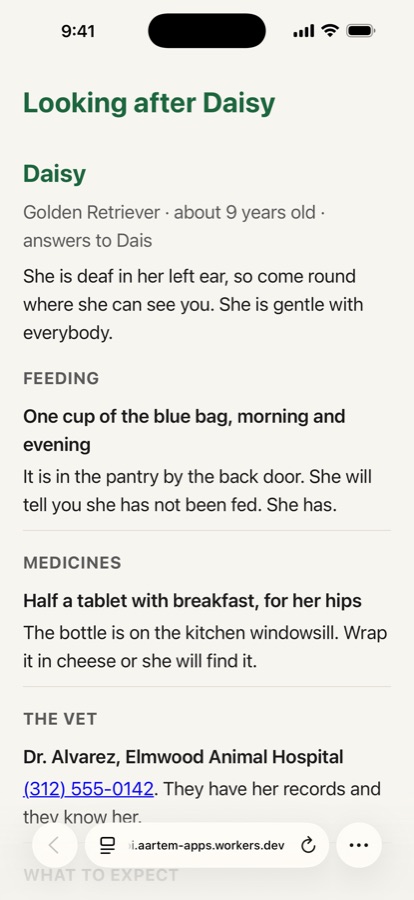
A plain page. No app to install, no account, no password. Who your animals are, what they eat and how much, which medicine and when, and the vet who knows them — laid out one animal at a time, because somebody in a hallway is dealing with one animal at a time.
If you do not own a printer
Most people this is built for do not. The card shares like any other document — send it to a son or daughter, save it to Files, print it at the library. The app does not care where it comes out.
Questions
- What should a pet emergency card say?
- How many animals are inside and what they are, their names, and a way to reach their full instructions — what they eat, their medicines and their vet. The ASPCA asks for the types and number of pets and the vet's number. Putting the vet's number on the door itself is the part worth reconsidering, because a front door is read by everybody who walks past it.
- What should never go on the card?
- Your address, your telephone number, and anything about getting into your home. A notice on a door tells a stranger that the house has animals in it and that the owner is not there — which is exactly the reason not to print your movements next to it.
- What if I do not have a printer?
- Send the card to somebody who does. Most people send it to a son or daughter, or save it to Files and print it somewhere else. The app shares it like any other document.
- Can someone scan the code and find out where I live?
- No. The page behind the code shows your animals and nothing about you or your home. Anything you wrote about getting into the house is held behind a separate check and can never be reached from the printed code.
The card is part of the subscription — $49.99 a year, or $79.99 once. Everything else, including telling your contact, is free.